The political and democratic march under Liberia’s ARREST Agenda: an in-depth analysis
Launched as Liberia’s National Development Plan for 2025–2029, the ARREST Agenda (Agriculture, Roads, Rule of Law, Education, Sanitation, Tourism) is both an ambitious development blueprint and a political project that shapes governance, state-society relations and democratization in the Boakai administration. The plan’s strengths lie in its clarity of priorities, broad consultative framing and alignment with international partners; early movements show improved coordination across ministries and heightened donor engagement. However, the democratic dividend of ARREST depends on how the government translates policy into transparent institutions, protects civic space and depoliticizes service delivery. Current indicators offer mixed signs — promising institutional commitments and county planning are counterbalanced by concerns about press freedom, civic space and implementation capacity.
1) What ARREST is and why it matters politically ARREST is Liberia’s fourth post-conflict national plan. It presents a compact set of sector priorities — Agriculture, Roads, Rule of Law, Education, Sanitation, Tourism — with an explicit linkage to Liberia Vision 2030 and the SDGs. The plan was publicly launched with a national rollout and county development agendas intended to anchor national policy at the local level. Politically, ARREST is both a governing programme and a narrative: it sets expectations about delivery, signals the administration’s focus areas, and becomes the yardstick by which citizens, opposition and partners judge performance.
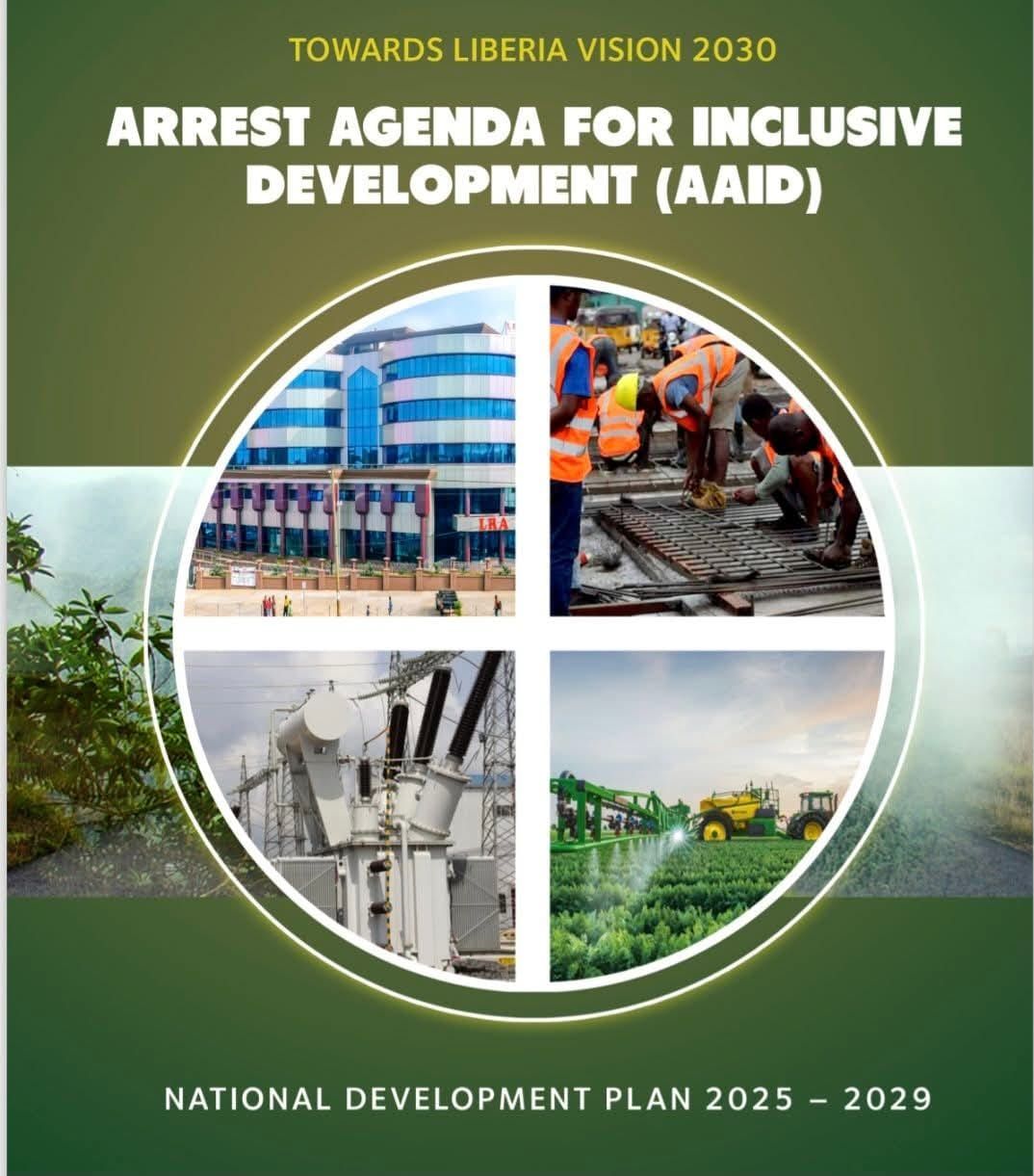
2) Early political and institutional effects a. Central coordination and policy clarity The Presidency and Finance & Development Planning have centralized the AAID/PSIP preparatory processes, producing a clearer line of sight between national priorities and public investment planning. That clarity helps the state speak with one voice to donors and investors — an important political asset for a country with limited fiscal space. b. County and political inclusion By pairing the national ARREST plan with 15 County Development Agendas (CDAs), the government signals a decentralizing impulse:
local priorities are explicitly incorporated, creating political avenues for county officials and local stakeholders to claim a stake in national outcomes. If implemented, CDAs can strengthen local accountability and reduce the perception that national projects are Monrovia-centric. c. Donor and partner alignment UN agencies, the Joint SDG Fund and other partners publicly endorsed and supported the AAID roll-out. This external backing boosts the administration’s capacity to finance and technically supports priority reforms, while binding the government to a set of internationally observable commitments.

3) Democratic implications — opportunities and red flags Opportunities Rule of law as a named priority. ARREST explicitly includes “Rule of Law,” elevating justice sector reform to the top policy tier. That creates a political opening for judicial strengthening, anti-corruption measures, and legal reforms that can entrench democratic norms if pursued with transparency and institutional independence. Planning + transparency potential. The public PSIP and the stated alignment with OGP/open-government processes create opportunities for more transparent budgeting and citizen monitoring — both essential to democratic accountability. Independent reviews (e.g., Open Government Partnership IRM) note alignment between Liberia’s OGP commitments and the ARREST plan, which can be leveraged to widen civic participation in oversight. Risks / red flags Civic space and press freedom concerns.
Independent monitors and civil-society groups have recorded incidents that raise concern about press freedom and peaceful assembly. If civic space narrows while executive power expands through centrally driven programmes, the democratic checks that ensure public accountability for ARREST investments can be weakened. Politicization of service delivery. County agendas can strengthen local governance — but they also risk becoming vehicles for patronage if implementation, procurement and job allocations are politicized. The assurance of technical neutrality in county planning and project selection will be critical. Capacity and fiscal constraint.

Ambitious targets (for example, the plan’s GDP and social indicator aspirations) require substantial financing and project management capacity. Failure to deliver visible benefits within the expected timeframe creates political backlash, which can heighten polarization. 4) Evidence of gains so far (first 12–24 months) Policy and institutional architecture: ARREST is formally adopted as the national development plan; PSIP and county agendas are in place — an accomplishment in planning coherence. High-level political buy-in and donor engagement: Public launches and UN/partner statements demonstrate consensus around the agenda and an influx of technical support. This raises the probability of externally supported projects that can deliver quick wins (roads, small-scale agricultural investments).

(That said, publicly available reporting on tangible delivery at scale — road networks completed, nationwide learning outcomes improved, or judicial reforms enacted — remains limited in the first years. Implementation reporting will be the next litmus test.) 5) Recommendations — how to secure a democratic march For the Government Institutionalize transparency: Publish a user-friendly ARREST performance dashboard (PSIP disaggregated by county, quarterly progress, procurement contracts).
Tie donor funding to public milestones. Protect civic space: public commitments to citizens’ right to assemble, independent media protections and an accessible grievance/feedback mechanism for ARREST projects. De-politicize county implementation: use independent technical selection committees for contractors and community-verified social audits. For the Legislature Strengthen budget scrutiny units and demand mid-year public reports on ARREST-funded projects. Conduct periodic public hearings in counties, not just Monrovia.

For Civil Society & Media Use the county agendas as entry points for watchdog monitoring: social audits, community scorecards and data-driven journalism. Forge partnerships with technical agencies to translate PSIP data into easily consumable public formats. For Development Partners Condition financing on transparency and independent monitoring clauses. Provide technical support for e-procurement, local government capacity building, and judicial reform programs. 6) Conclusion The ARREST Agenda is an important political and development milestone: it gives Liberia a clear, consultative five-year plan and the rhetorical frame necessary to mobilize partners and citizens. But its democratic legacy is not automatic.
To convert the plan into strengthened democratic governance, the administration must pair delivery with institutional safeguards — transparent budgeting, independent oversight, protection of civic freedoms, and a genuine decentralization of power and resources. If those conditions are met, ARREST could deepen Liberia’s democratic march; if not, it risks becoming another technocratic plan that widens expectations without consolidating the institutions needed to sustain them. Sidebar suggestion (for layout) ARREST at a glance Period: 2025–2029 (National Development Plan). Acronym: Agriculture | Roads | Rule of Law | Education | Sanitation | Tourism. Public launch: Buchanan, Grand Bassa (Jan 15, 2025) — national rollout + County Development Agendas.
Stated targets (examples cited in plan): GDP growth and social indicator improvements referenced in PSIP projections (source: AAID) Momolu V. O. Sirleaf is a distinguished Liberian journalist whose career has spanned more than two decades across Liberia and the United States. Over the years, he has worked with—and served as editor for—several of Liberia’s leading sports publications, earning a reputation for excellence, integrity, and depth in sports reporting and analysis. He holds a Master’s Degree in Global Public Policy from the Hubert H. Humphrey School of Public Affairs at the University of Minnesota, USA, and a Bachelor’s Degree in Financial Management from National American University in Minnesota.